
Cybersecurity has always been a race between attackers and defenders. AI is accelerating that race, giving both researchers and attackers new ways to identify and act on vulnerabilities faster.
AI is accelerating familiar attack methods, making strong cybersecurity fundamentals more important than ever.
The scale of the challenge is changing
Common Vulnerabilities and Exposures (CVE) disclosures have increased sharply in recent years, creating more findings for security teams to assess, prioritize, and remediate. AI-assisted discovery is adding to an already accelerating environment.
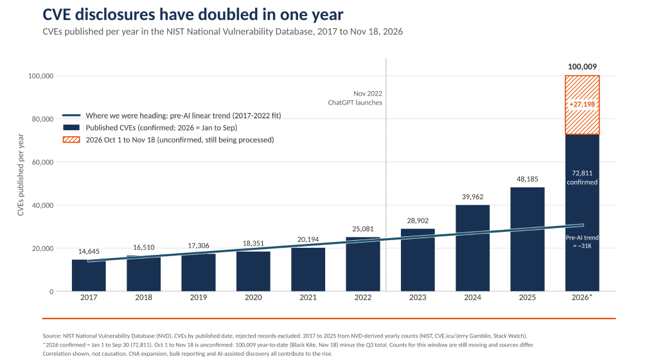
Volume, however, is only part of the story. Speed may be the more consequential change.
Attacks are moving faster, but response times are not
Recent events show how quickly agentic AI can move through the stages of a cyberattack.
The FBI recently warned that threat actors are using ARTEX, an AI-enabled penetration-testing framework, to automate activities ranging from reconnaissance and vulnerability exploitation to credential theft and data exfiltration. In some observed cases, attackers progressed from initial targeting to privileged access in under three hours.
The significance is that the techniques themselves are not new. Attackers are still looking for vulnerable applications, insecure code, compromised credentials, weak configurations, excessive privileges, exposed systems, and other gaps that security teams have been managing for years.
What is changing is how quickly those gaps can be identified and exploited.
One recent incident makes that challenge particularly tangible. The Dutch Institute for Vulnerability Disclosure was compromised through vulnerabilities in its ticketing environment. Indicators of the attack appeared in monitoring systems within minutes. Yet initiating the response took 19 hours, followed by another nine hours to execute containment.
Detection speed is not the same as response speed.
In an era of agentic attacks, organizations need more than alerts. They need the ability to rapidly understand what matters, identify who owns the response, make decisions, and take action without introducing new operational risk.
Leveraging offense as defense
AI does not have to work only for attackers. Defenders can use it to analyze high volumes of security data, filter noise from logs, connect signals across the organization, and focus teams on the activity most likely to require action.
Organizations can also adopt an attacker’s perspective through continuous or more frequent penetration testing. By repeatedly testing externally visible systems, identities, and applications, security teams can identify weaknesses before an adversary does and validate whether defensive controls are working as intended.
Why this matters differently in life sciences
For life sciences organizations, that challenge can be particularly complicated.
Pharma, biotech, medical device companies, CROs, CDMOs, and laboratories often operate across interconnected technology environments that include corporate IT, cloud services, third-party platforms, sensitive clinical or regulated data, laboratory and manufacturing technology, and validated systems. These complex, highly controlled environments can make rapid change difficult, even when the risk demands urgent action.
A cybersecurity event therefore is not necessarily just an IT problem. It can quickly become an organization-wide capacity challenge that requires coordinated action across security, IT, operations, quality, and business leadership.
A critical vulnerability can quickly create questions for security, IT, operations, quality, and business leadership:
- What systems are exposed?
- How significant is the vulnerability, and is it actively being exploited?
- What business processes depend on the affected technology?
- Can a change be implemented quickly and safely?
- If the affected system is validated, what testing or change-control requirements need to be considered?
- What happens if the remediation itself causes disruption?
- Could the vulnerability or its remediation affect validated systems, including those supporting clinical trials?
The challenge is not simply patching faster. It is getting the organization to act faster without disrupting business operations or introducing new quality, validation, or patient-safety risk.
What we’re seeing firsthand
Our experience at CREO reinforces the importance of getting the fundamentals right.
20–30 security recommendations or misconfigurations identified, on average, across CREO’s last three Microsoft 365 security assessments. These are often security capabilities organizations already license but have not fully configured or enabled.
20,000+ vulnerabilities recently remediated across several client environments in partnership with CREO.
As AI accelerates the threat environment, leaders often ask, “Where do we start?” Our answer is consistent: start with the foundation of cybersecurity.
That means asking six basic but increasingly important questions:
1. Do we know what we have? Do we have an accurate view of our assets, identities, third-party connections, and critical systems?
2. Are the fundamentals consistently in place? Are controls such as MFA, privileged-access management, secure configurations, vulnerability management, and patching functioning the way we believe they are?
3. Are we prioritizing the right risks? Are vulnerabilities considered in the context of exploitability, exposure, business criticality, and potential impact rather than treated as an undifferentiated backlog?
4. Can we respond at the necessary speed? Can monitoring, decision-making, remediation, and incident response keep pace when an attack unfolds in minutes instead of days?
5. Can we change safely? When a critical remediation is required, can we implement it without creating unnecessary operational, quality, or validation risk?
6. Are we seeing the full range of risk? Not every risk can be detected by a scanner. Guided conversations with business, technology, quality, and operational stakeholders can reveal dependencies and exposures that technical tools alone may miss.
The advantage is readiness
AI will continue to improve the capabilities available to attackers. It will also give defenders better tools to identify vulnerabilities, investigate threats, and respond more quickly.
The organizations best positioned for that environment will not necessarily be those with the most security technology. They will be the organizations that understand their environments, consistently execute the fundamentals, prioritize the risks that matter, and can make sound decisions quickly when something changes.
For life sciences leaders, that makes cybersecurity more than a technical discipline. It is becoming an organizational readiness capability.
The question worth asking is not simply, “Are we protected?”
If an attacker tested our environment today, what would they find, and how quickly could we respond?
CONNECT WITH THE AUTHORS
AI is changing the speed of cyber risk. The question is whether your cybersecurity foundation can keep pace.
Contact CREO to discuss how your current cybersecurity approach compares with what we’re seeing across life sciences organizations.